
Know how creative your country’s children are, from age 6.
Measure creativity across your schools with the NEOMI test, then raise it with the NEOMI programme where the data shows gaps. Start with a free pilot in selected schools and receive a report your team can act on.
Creativity is now measured internationally
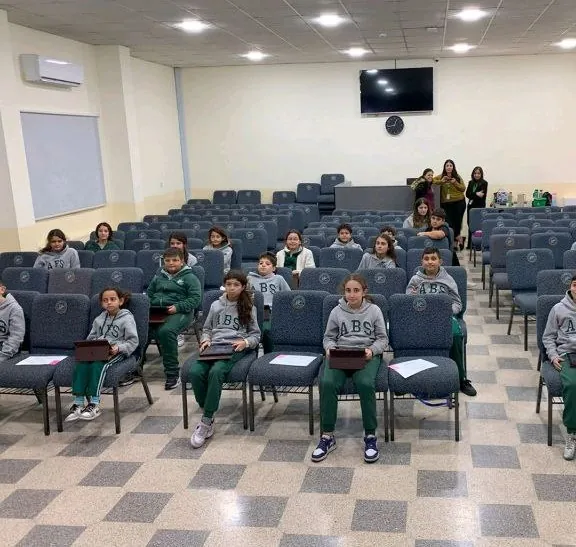
In 2022, the OECD’s PISA assessment measured creative thinking across countries for the first time, at age 15. NEOMI measures it every year from age 6, in line with the three processes PISA assesses: generating diverse ideas, generating creative ideas, and evaluating and improving ideas. Your team sees the trend long before students reach that test, and can act on it.
“Developing an international assessment of creative thinking can encourage positive changes in education policies and pedagogies.”
Creativity is also an economic indicator
3.1% of world GDP came from the cultural sector in 2020.
57% of employers call creative thinking a core skill.
84% of US high-school students used AI for schoolwork by May 2025.
Two ways to work with us
Measure creativity on its own, or measure it and raise it with the NEOMI programme.
A national creativity assessment
The test on its own
Students in selected schools, or across a region, take the AI-scored test. Your team receives results by school and region, and a baseline to measure against.
- A baseline from age 6
- Gaps by region, school type and background
- Instant results, with a rapid version
- Priced per student tested
Assessment and the programme
Measure, then grow
Add the NEOMI programme and teacher training in the schools where the data points, then test again to prove the impact and fund what works.
- Everything in the assessment
- The NEOMI programme in selected schools
- Teacher training
- A second test that shows the change
Both can start the same way: a free pilot in selected schools.
What your ministry gets
A baseline from age 6
Creativity data from age 6, years before PISA tests students at 15.
Reports at every level
Results by student, class, school and region, so your team can compare and plan.
Equity tracking
See gaps by region, school type and background, and where to direct support.
A national KPI
A creativity measure, re-tested each year, that links classrooms to creative-economy goals.
A national pilot, step by step
Choose pilot schools
We agree the schools and regions with your team.
Set up and train
We set up NEOMI and train the teachers who will run it.
Baseline test
Students take the AI-scored creativity test.
Your report
Your team receives results by school and region.
Grow and re-measure
Schools run the programme, then students are tested again.
Built on decades of creativity research
Two traditions shape how NEOMI measures creativity, and three shape how it grows it.
How we measure
- Guilford
- J.P. Guilford’s model of divergent thinking, the origin of fluency, flexibility, originality and elaboration: the 4 core skills the test scores.
- Torrance
- E. Paul Torrance’s Tests of Creative Thinking, the most widely used creativity assessment, the model for how the test tasks are built and scored.
How we grow it
- De Bono’s lateral thinking
- Techniques for escaping obvious answers and reframing problems, used in activities that push for original solutions.
- SCAMPER
- Substitute, Combine, Adapt, Modify, Put to another use, Eliminate, Reverse: the steps students use to redesign their own creations.
- Langer’s mindfulness
- Ellen Langer’s idea of noticing new things and seeing more than one perspective, used to build the habit of questioning first ideas.
Shortlisted, selected, and already in 39 schools
NEOMI is used by 39 schools and 2 universities in 5 countries, directly and through regional partners.
NEOMI at Al Kifah Academy
+56%higher average creativity score after the programme: from 72 to 112.
- Before the programme
- After the programme
| Before the programme | 72 |
|---|---|
| After the programme | 112 |
More than 200 students in grades 6 to 9 took the test before and after the programme in 2023. The whole curve shifted to higher scores, not just its top end.
Study by Just to Learn with Al Kifah Academy. The curves are redrawn from the study’s chart.
Shortlisted for the QS Reimagine Education Awards 2026
In the Developing Emerging Skills & Competencies category.
Selected for the AI Hub for Sustainable Development
A G7-endorsed initiative co-led by UNDP and Italy’s Ministry of Enterprises and Made in Italy.
Selected for Cyber4Africa
A six-month programme by the AI Hub, Cyber 4.0 and Cisco Kenya that builds security-by-design into African AI startups.
Inventors of Tomorrow: AI + NEOMI
A cars and mobility workshop for 12 to 14 year-olds, run with NEOMI at the Autostadt Learning Lab, Volkswagen Group, Germany.
Countries include
- Egypt
- Jordan
- Germany
- Saudi Arabia
Partners



Support for the whole programme
A programme across many schools needs trained teachers, good digital content and a plan for the rollout. Just to Learn provides all three, alongside NEOMI.
Ask about these servicesTeacher capacity building
Training for teachers and instructional teams in modern teaching methods, assessment and education technology, delivered on-site or online.
Digital courses and learning platforms
We turn curricula into interactive courses that run on any learning management system, and can set up, customise and manage the platform that hosts them.
Rollout and change support
We assess current teaching methods, content, technology and processes against where you want to be, design practical processes, and help sequence the change so it takes root.
Questions ministries ask
Can we buy the assessment without the programme?
Yes. The assessment works on its own as a baseline study. You can add the programme later in the schools where the results show gaps.
Which ages does NEOMI cover?
The programme is designed for children aged 6 to 12. The test starts at age 6, and universities use it too.
Can results be reported by region?
Yes. Reports go from each student and class up to school and region level.
How large is a pilot?
We agree the number of schools with your team, based on what you want to learn and where.
Where has NEOMI been used?
In Egypt, Jordan, Germany and Saudi Arabia, including a workshop at the Volkswagen Group’s Autostadt learning lab.
Request a pilot for your country
Tell us about your ministry or agency and what you want to learn. Our partnerships team will reply to plan the pilot with you.
- A free pilot in selected schools
- A baseline creativity report
- Teacher training included